As a web developer, I have developed a profound passion for designing. I find the process fascinating, especially when I get to work with illustration tools like pentools and color gradients. I hold Figma, a powerful design tool, in the highest regard as it empowers me to transform my creative concepts into reality. Exploring the world of UI/UX design has been an incredible journey, and I am excited to continue honing my skills in this dynamic and rewarding field.
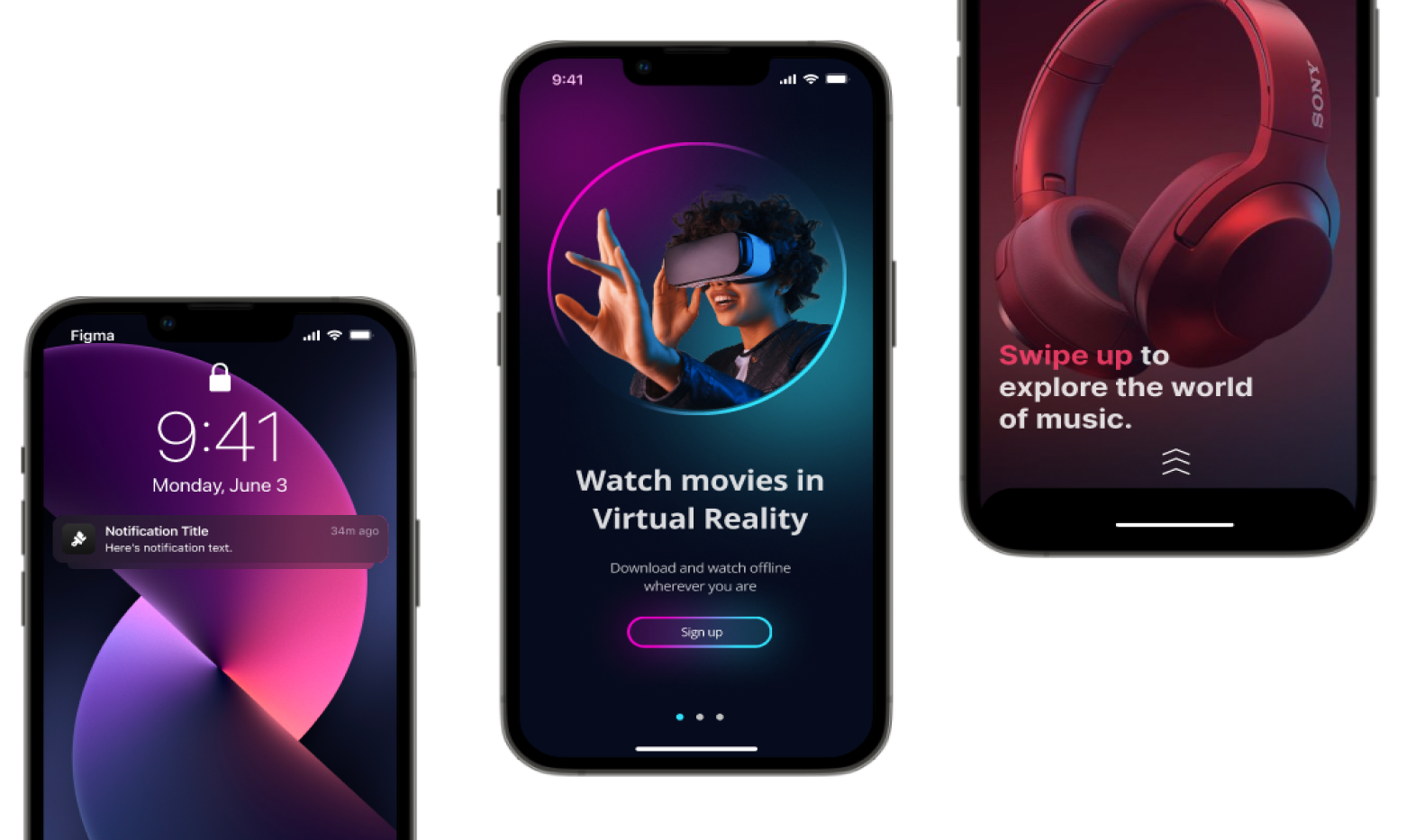
The VR Movie App design for mobile, meticulously crafted using Figma. Drawing inspiration from the dynamic world of virtual reality, I chose a neon color theme that effortlessly complements the dark background, resulting in a profound and immersive VR experience.
The synergy of Figma's powerful design capabilities and prototyping allows us to craft a design experience that not only looks impressive but also feels incredibly intuitive.With its fabulous smart animate on drag feature, this login screen effortlessly responds to user interactions, creating a dynamic and immersive experience. As users drag, they are met with smooth and seamless transitions.
Optical illusion shapes, also known as impossible shapes or ambiguous figures, are intriguing and visually deceptive designs that challenge our perception and cognitive understanding. These shapes often appear paradoxical or impossible, defying traditional three-dimensional interpretations while appearing plausible at first glance.
From the elegant curves of spacetime, as described by Einstein's theory of relativity, to the mesmerizing fractals that emerge from chaos theory, each shape tells a unique story of the underlying physical phenomena. These captivating forms not only reveal the beauty and order inherent in the universe but also serve as a testament to the brilliance of human intellect in unraveling its mysteries.
I enthusiastically experimented with Figma's exceptional tools, such as the Pen Tool, Shape Builder, and Color Gradients. The process was nothing short of exhilarating as I skillfully crafted a collection of awe-inspiring shapes. Through these powerful features, Figma allowed me to explore and create designs that challenge perception and ignite fascination. Following are some shapes that unexpectedly turned out to be great:
The Penrose Triangle, also known as the "impossible triangle," is a fascinating optical illusion and geometric shape that challenges our perception of three-dimensional space. It was first created by the Swedish artist Oscar Reutersvärd in 1934, but later popularized by the British mathematician and philosopher Roger Penrose in the 1950s.
A 3D optical illusion polygon is a geometric shape that appears to be three-dimensional and possesses depth, but it is actually a 2D representation on a flat surface. These polygons often use clever shading, perspective, and spatial arrangements to trick the viewer's perception, creating the illusion of a three-dimensional object.
I’m not that good at logos designing but I was always inspired by designs so I decided to push my boundaries. So I came up waith an idea to start with a grid of horizontal and vertical lines. Later I tried to merge some shapes into the grid and I found that all the combinations of letters can be drawn on that grid. Following are some logos that unexpectedly turned out to be great:
Plantify.Co is an online plant store of a friend of mine. When you can draw few logos etc you have to draw logos for your friends and family members too. And yes, I did this too. I just drew a logo, picked a font pair and also designed advertisement posts for his store.